

Korean banks should prepare all three tracks of tokenised money
Deposit tokens, a bank-issued won stablecoin and services for third-party stablecoins: banks need all three before the law passes, not after.
- To
- Korean commercial banks; Bank of Korea; Financial Services Commission
- From
- Kang Hee-chang, CSO, Four Pillars (report)
- Date
- 2026.08.20
 2026.08.20
What we ask
- Use Project Hangang to build deposit-token products and operating experience now.
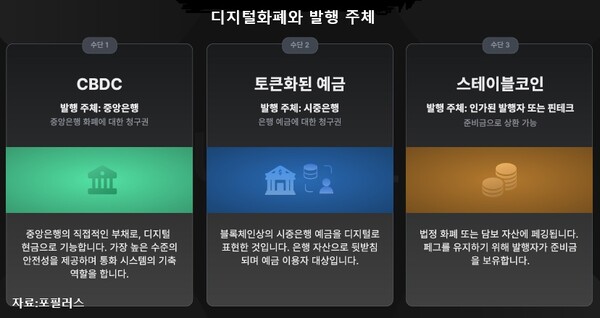
- Prepare a won stablecoin, alone or through a subsidiary or consortium, ready to launch when the Digital Asset Basic Act passes.
- Offer custody, exchange, payment and trading services for third-party stablecoins so customers do not leave the bank network.
Assets now move 24 hours a day, but bank money still keeps banking hours. Securities settlement, repo and margin already run on-chain, while the cash leg still moves through legacy rails.
If banks do not provide tokenised money, customers will use stablecoins. The real threat is not lost payment fees but lost deposits.
Why deposits are at stake
The US Treasury Borrowing Advisory Committee estimates about $6.6 trillion of transactional deposits could move to stablecoins, and the stablecoin market is forecast to reach about $2 trillion by 2028.
A stablecoin pulls money out of the bank. A deposit token keeps the claim on the bank's balance sheet and moves only the record on-chain. J.P. Morgan's JPMD, which runs on a public chain but only for verified institutions, is the benchmark.
Project Hangang as the testbed
Under the Bank of Korea's Project Hangang, commercial banks issue deposit tokens on top of wholesale central bank money. Seven banks joined the first live phase; nine are in the second, with live tests of peer-to-peer transfers and automatic deposit conversion due in the second half of 2026.
The third track is the one banks overlook. While their own stablecoin waits for the law, customers using foreign stablecoins can simply walk out of the bank network.
Adapted from WealthM: ‘토큰화 예금’ 전쟁 가속 [WM 이슈 리포트] (Korean).